Design Technology at Horizon
Imagine it.
Design it. Make it.
Explore how students turn ideas into practical outcomes through design, making and evaluation.
DT curriculum intent
Design and Technology develops students’ understanding of the ‘physical’ world. They learn to design, make and evaluate everyday products, considering their own and others’ needs, wants and values. Key concepts include creativity and imagination. Rather than contribute to a disposable society, students become proactive thinkers, able to appreciate the effort, time and resources used to create all products. They explore how they can reduce their impact while still having an impact.
What do we learn
Explore the topics and skills students develop in our curriculum roadmaps.
Key Strands
Design
- use research and exploration, such as the study of different cultures, to identify and understand user needs
- identify and solve their own design problems and understand how to reformulate problems given to them
- develop specifications to inform the design of innovative, functional, appealing products that respond to needs in a variety of situations
- use a variety of approaches [for example, biomimicry and user-centred design], to generate creative ideas and avoid stereotypical responses
- develop and communicate design ideas using annotated sketches, detailed plans, 3-D and mathematical modelling, oral and digital presentations and computer-based tools
Make
- select from and use specialist tools, techniques, processes, equipment and machinery precisely, including computer-aided manufacture
- select from and use a wider, more complex range of materials, components and ingredients, taking into account their properties
Evaluate
- analyse the work of past and present professionals and others to develop and broaden their understanding
- investigate new and emerging technologies
- test, evaluate and refine their ideas and products against a specification, taking into account the views of intended users and other interested groups
- understand developments in design and technology, its impact on individuals, society and the environment, and the responsibilities of designers, engineers and technologists
Technical Knowledge
- understand and use the properties of materials and the performance of structural elements to achieve functioning solutions
- understand how more advanced mechanical systems used in their products enable changes in movement and force
- understand how more advanced electrical and electronic systems can be powered and used in their products [for example, circuits with heat, light, sound and movement as inputs and outputs]
- apply computing and use electronics to embed intelligence in products that respond to inputs [for example, sensors], and control outputs [for example, actuators], using programmable components [for example, microcontrollers]
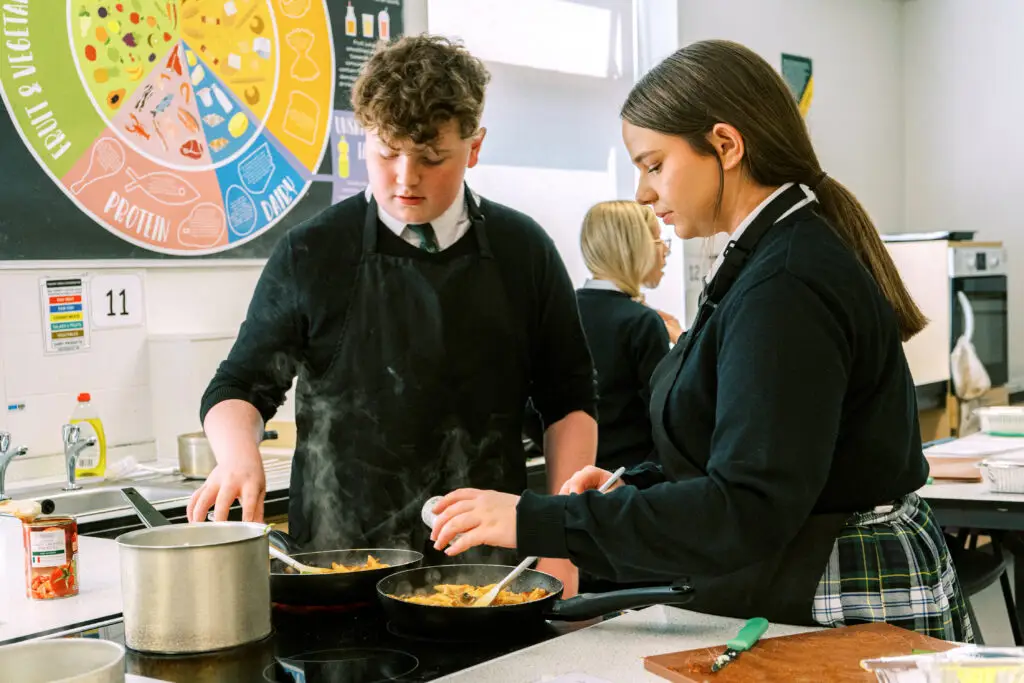
Cooking & Nutrition
- understand and apply the principles of nutrition and health
- cook a repertoire of predominantly savoury dishes so that they are able to feed
- themselves and others a healthy and varied diet
- become competent in a range of cooking techniques [for example, selecting and
- preparing ingredients; using utensils and electrical equipment; applying heat in different
- ways; using awareness of taste, texture and smell to decide how to season dishes and
- combine ingredients; adapting and using their own recipes]
- understand the source, seasonality and characteristics of a broad range of ingredients.
Key Strands
Component 1: Portfolio 60%
Each student must select and present a portfolio representative of their Textile work.
The portfolio must include both:
Cooking & Nutrition
- A sustained project developed in response to a subject, theme, task or brief evidencing the journey from initial engagement with an idea(s) to the realisation of intentions.
- A selection of further work resulting from activities such as trials and experiments; skills-based workshops; mini and/or foundation projects; responses to gallery, museum or site visits; work placements; independent study and evidence of the student’s specific role in any group work undertaken.
Graphics
Resistant Materials
Textiles
Keep exploring
Your next steps
Here to help
Curious about
this subject?
Our college team can point you towards the right information.
Contact the college